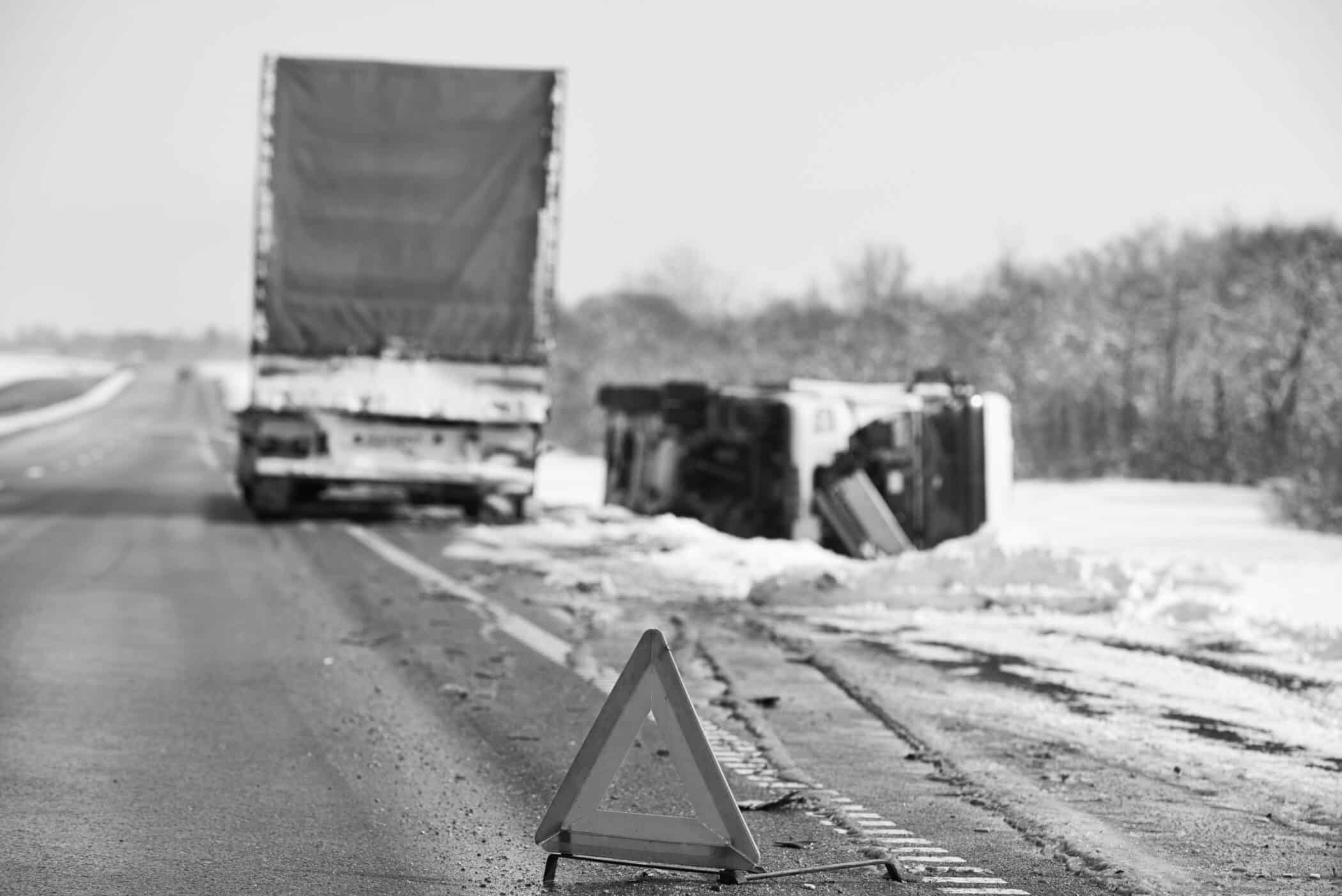
When a semi slides off an icy interstate or slides/jackknifes into traffic, the trucking company usually blames the weather or the driver. But federal law makes the motor carrier responsible for making its drivers slow down, or stop, when winter conditions turn dangerous. A winter truck crash in North Dakota is often a company failure: a failure to train, supervise, and let drivers park the truck.
Trucking companies like to say, “Our drivers are professionals. They know what to do in the snow.” That is not a safety program. It is an excuse. Here is what every motor carrier must do this winter, and what it means for you if a semi-truck crash has injured you or someone you love.
What Does 49 C.F.R. § 392.14 Require in Winter Weather?
Federal regulation 49 C.F.R. § 392.14 requires truck drivers to use “extreme caution” when snow, ice, sleet, fog, or similar conditions reduce visibility or traction. Drivers must reduce speed, and must stop driving when conditions become “sufficiently dangerous.” The rule reads:
“Extreme caution in the operation of a commercial motor vehicle shall be exercised when hazardous conditions, such as those caused by snow, ice, sleet, fog, mist, rain, dust, or smoke, adversely affect visibility or traction. Speed shall be reduced when such conditions exist. If conditions become sufficiently dangerous, the operation of the commercial motor vehicle shall be discontinued and shall not be resumed until the commercial motor vehicle can be safely operated. Whenever compliance with the foregoing provisions of this rule increases hazard to passengers, the commercial motor vehicle may be operated to the nearest point at which the safety of passengers is assured.”
“Extreme caution” is a higher standard than the ordinary care expected of other drivers. I covered this regulation in an earlier post on § 392.14 and the CDL manual. The stakes are high: according to the Federal Highway Administration, 24% of weather-related crashes happen on snowy, slushy, or icy pavement, killing more than 1,300 people and injuring more than 116,800 each year.
What Does Section 2.6.2 of the CDL Manual Say About Snow and Ice?
Section 2.6.2 of North Dakota’s commercial driver’s license (CDL) manual, “Matching Speed to the Road Surface,” gives truck drivers specific numbers:
“Reduce speed by about one-third (e.g., slow from 55 to about 35 mph) on a wet road. On packed snow, reduce speed by a half, or more. If the surface is icy, reduce speed to a crawl and stop driving as soon as you can safely do so.”
Every CDL holder studies this manual to pass the knowledge test. On most parts of I-29 or I-94 the speed limit is 80 mph. On packed snow, that means 40 mph or less. On ice, the truck should barely be moving, or parked. The manual also notes that a truck at 55 mph on dry pavement needs at least 419 feet to stop, and wet roads can double that distance.
Is the Trucking Company Responsible, or Just the Driver?
The trucking company is responsible too. Under 49 C.F.R. § 390.11, whenever a federal rule imposes a duty on a driver, “it shall be the duty of the motor carrier to require observance of such duty or prohibition.” In plain terms, the trucking company must make its drivers follow § 392.14. It cannot hand over the keys and hope for the best.
Two other rules back this up. 49 C.F.R. § 392.6 bars a carrier from scheduling a run that requires speeding to make delivery. And 49 C.F.R. § 390.6 prohibits carriers, shippers, and brokers from coercing drivers to break safety rules, including by threatening their jobs or loads.
North Dakota law adds two layers. “Vicarious liability” makes an employer responsible for an employee’s negligence on the job. N.D.C.C. § 3-03-09. An employer can also be directly liable for negligently supervising an employee.
Why “They’re Professional Drivers” Is Not a Defense
Knowing a rule and enforcing it are two different jobs. Federal law requires CDL applicants to know about “extreme driving conditions,” including snow and ice. 49 C.F.R. § 383.111(a)(12). But passing a test once, maybe years ago, is not ongoing training. And it does nothing about the pressure the company creates.
The company sets delivery appointments and dispatches loads into storms. Many companies pay by the mile, so a driver who parks for a blizzard loses money. When a dispatcher asks, “Can you still make it by 6 a.m.?” during a no-travel advisory, the message is clear.
In 2020 alone, the Federal Motor Carrier Safety Administration reported 91 fatal crashes involving large trucks on snow, ice, frost, or slush, plus thousands of injury and property-damage crashes on the same surfaces, according to FMCSA crash data. Behind many of those numbers is the same choice: a truck kept moving too fast when it should have slowed down or parked.
What Should a Responsible Motor Carrier Do Before Winter?
A responsible motor carrier prepares its drivers before the first storm, not after the first crash. At a minimum, that means five things.
1. A written winter-weather policy with clear triggers
The policy should adopt the CDL manual’s speed reductions and require drivers to park during no-travel advisories, road closures, and whiteouts. “Use good judgment” is not a policy.
2. Annual winter training
Every fall, drivers should be retrained on § 392.14, Section 2.6.2, black ice, and bridges, with documented dates and content. Drivers new to northern routes need extra attention.
3. Dispatchers who watch the weather
Dispatch should monitor the NDDOT travel map and National Weather Service warnings, hold loads when routes close, and build schedules that allow for slower winter speeds.
4. Real authority to stop, with no punishment
Drivers must know they can park without losing pay, loads, or their job. Federal law already protects drivers who refuse to drive in violation of a safety regulation. 49 U.S.C. § 31105(a)(1)(B).
5. Monitoring speed and enforcing the rules
Most trucks record speed through telematics. A responsible carrier reviews that data during storms and coaches or disciplines drivers who run too fast for conditions.
Talk to a North Dakota Truck Accident Lawyer About Your Winter Crash
Winter truck crashes are not inevitable. Federal law requires trucking companies to train their drivers, enforce speed reductions, and back up drivers who park when conditions turn bad. When a company relies on “they’re professional drivers” instead of real training, it should be held accountable.
Our personal injury team at SW&L Attorneys understands, knows, and handles all trucking and commercial motor vehicle accidents. To get in touch with our team, call (701)297-2890, or email info@swlattorneys.com.
Please read the disclaimer here.